
Operations
Here you will find answers to operation questions in ICND 1 exam
Question 1:
Refer to the exhibit. The junior network support staff provided the diagram as a recommended configuration for the first phase of a four-phase network expansion project. The entire network expansion will have over 1000 users on 14 network segments and has been allocated this IP address space:
192.168.1.1 through 192.168.5.255
192.168.100.1 through 198.168.100.255
What are three problems with this design? (Choose three)
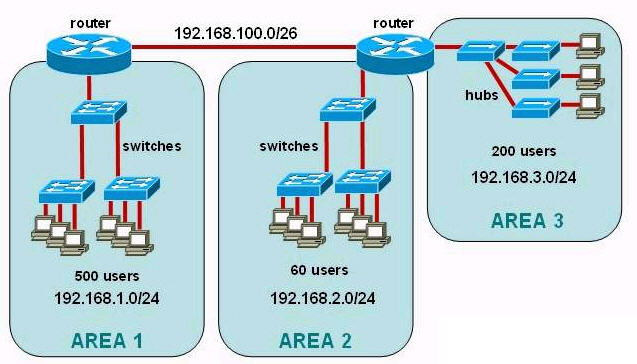
A – The AREA 1 IP address space is inadequate for the number of users.
B – The AREA 3 IP address space is inadequate for the number of users.
C – AREA 2 could use a mask of /25 to conserve IP address space.
D – The network address space that is provided requires a single network-wide mask.
E – The router-to-router connection is wasting address space.
F – The broadcast domain in AREA 1 is too large for IP to function.
Answer: A C E
Question 2:
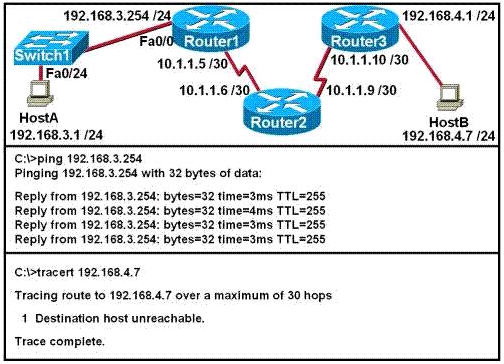
Refer to the exhibit. A technician is testing connection problems in the internetwork. What is the problem indicated by the output from HostA?
A – The routing on Router2 is not functioning properly.
B – An access list is applied to an interface of Router3.
C – The Fa0/24 interface of Switch1 is down.
D – The gateway address of HostA is incorrect or not configured.
Answer: D
Explanation:
When trying to ping the IP 192.168.3.254,you received the replies from that IP. It means that you can reach the Fa0/0 interface of Router1. But notice that the IP of host A (192.168.3.1/24) and the IP of the Fa0/0 interface of Router 1 (192.168.3.254/24) are on the same network. So you don’t need a gateway address configured on HostA. Therefore you can’t conclude the gateway address of HostA was configured correctly.
Lately, you tried to use the tracert command to reach another network (192.168.4.7). In this case, a gateway address was required for reaching the network of hostB. But the result told that “Destination host unreachable” – means that Host A can not find a route to Host B -> The gateway address of Host A was incorrect (something other than 192.168.3.254) or not configured is a possibility.
A and B are incorrect because if there is a mis-configuration on Router 2 or Router 3 (while Router 1 is configurated correctly), you will see at least one successful line when using tracert command likes the bold line below:
PC>tracert 192.168.4.7
Tracing route to 192.168.4.7 over a maximum of 30 hops:
1 62 ms 62 ms 46 ms 192.168.3.254
2 * * * Request timed out.
C is incorrect because we can ping Router 1 -> port Fa0/24 on Switch 1 was turned on and running correctly.
Question 3:
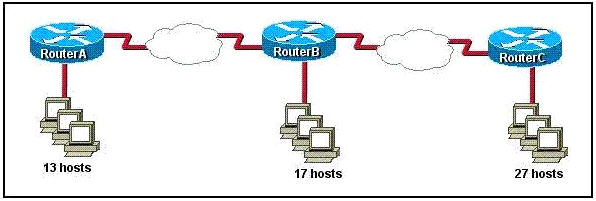
Refer to the exhibit. The internetwork is using subnets of the address 192.168.1.0 with a subset mask of 255.255.255.224. The routing protocol in use is RIP version 1. Which address could be assigned to the FastEthernet interface on RouterA?
A – 192.168.1.31
B – 192.168.1.64
C – 192.168.1.127
D – 192.168.1.190
E – 192.168.1.192
Answer: D
Explanation:
255.255.255.224 = 1111 1111.1111 1111.1111 1111.1110 0000 (binary form)
Increment: 32
First subnetwork: 192.168.1.0 -> 192.168.1.31 (A is incorrect because 192.168.1.31 is a broadcast address)
Second subnetwork: 192.168.1.32 -> 192.168.1.63
Third subnetwork: 192.168.1.64 -> 192.168.1.95 (B is incorrect because 192.168.1.64 is a network address)
Fourth subnetwork: 192.168.1.96 -> 192.168.1.127 (C is incorrect because 192.168.1.127 is a broadcast address)
Fifth subnetwork: 192.168.1.128 -> 192.168.1.159
Sixth subnetwork: 192.168.1.160 -> 192.168.1.191 (D is correct because 192.168.1.190 is the last assignable host address of this subnetwork)
Seventh subnetwork: 192.168.1.192 -> 192.168.1.224 (E is incorrect because 192.168.1.192 is a network address)
Question 4:
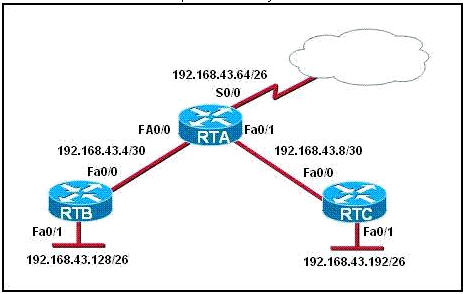
Refer to the exhibit. For security reasons, information about RTA, including platform and IP addresses, should not be accessible from the Internet. This information should, however, be accessible to devices on the internal networks of RTA. Which command or series of commands will accomplish these objectives?
A – RTA(config)#no cdp run
B – RTA(config)#no cdp enable
C – RTA(config)#interface s0/0
RTA(config-if)#no cdp run
D – RTA(config)#interface s0/0
RTA(config-if)#no cdp enable
Answer: D
Question 5:
Refer to the exhibit, PC1 pings PC2. What three things will CORE router do with the data that is received from PC1? (Choose three)
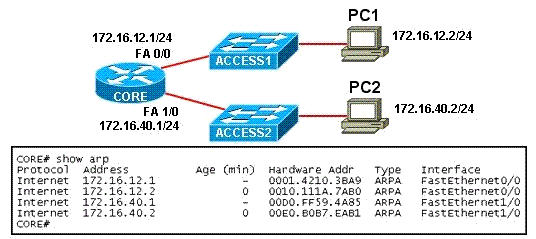
A – The data frames will be forwarded out interface FastEthernet0/1 of CORE router.
B – The data frames will be forwarded out interface FastEthernet1/0 of CORE router.
C – CORE router will replace the destination IP address of the packets with the IP address of PC2.
D – CORE router will place the MAC address of PC2 in the destination MAC address of the frames.
E – CORE router will put the IP address of the forwarding FastEthernet interface in the place of the source IP address in the packets.
F – CORE router will put the MAC address of the forwarding FastEthernet interface in the place of the source MAC address.
Answer: B D F
hi 9tut..thanks for your site..it’s very helpful..
i still confuse the answer of Q3..
Address to interface router should be used network address, right ? why we used ip address to assign the fa to router ?
My answer is D, since it should subnet the 224 to 240 because the host number in A is 13 hosts..
is it correct answer ? please kindly advised ..thanks..
D is the correct answer for Q3
Hi 9tut, seems that answers B,C,D,F are all correct for question 5. Why C got left out? Can you explain?
The destination IP address is also the IP address of PC2 so there is nothing to “replace” here.
hi 9tut,
This website is very good and I really got confidence on sim questions after going thru ur website.
I took the exam 3 times and failed and I lost interest. But today , I am thinking to retake after going thru ur website.
Do you have switch related questions ? Like, 9 hosts connected to one hub and hub is connected to swithc1. There is one more set of 10 hosts connected to swithc2. switch1 willl be connected to switch2.
New host is connected to switch1 and please explain me what will happen in the flooding of frames? Does switch need some config after connecting new host?
And also, I have seen DHCP drag and drop questions. I did not prepare for part1 exam atleast. do you have any questions on this?
I appreciate your help.
Thanks a lot in advance.
For the 9 hosts connected to one hub please read http://www.certprepare.com/forum/index.php?showtopic=143
I am not sure about DHCP Drag drop question, review your knowledge about this subject. Maybe you should read DHCP Group of 4 Questions http://www.9tut.com/component/content/article/41-ccnahotspotquestions/67-dhcp-group-of-four-questions
hey 9tut can u explain the difference between
no cdp run & no cdp enable as in Q-4
as i got it
no cdp run will shut down the cdp all over the router
but no cdp enable will just affect the interface
@mahmoud
You are correct. The question stated only the s0/0 should have cpd disabled, which is why the ‘no cdp enable’ command was used only on int s0/0
Bi-An
Thats backwards the subnet mask would give 13 subnets not 13 hosts, d is correct because it’s the only address given tht’s not a Subnet or broadcast.
passed the exam today.. this was one of the question – but couldnt remember the options..
PS#telnet http://www.cico.co
Translating “www.cico.co”…domain server (255.255.255.255)
% Unknown command or computer name, or unable to find computer address
9tut
Question 3 indicates RIP version 1 is being used. RIP V1 is classfull so wouldn’t subnetting not work correctly because the router is not passing on the subnet mask of 255.255.255.224?
Thank you
I had given my ICND exam 1 recently. Got 700. Will be giving the exam next week? There was a question: to identify the cable from the diagram: Ethernet Cross-over Cable, Serial Cross-over Cable, Ethernet Straight Cable, Serial Straight Cable, Rollover cable.
Does anyone have the diagrams for all these cables?
Answer to above question: Ethernet cross over cable.
http://img62.imageshack.us/i/schemay.jpg/
A. a rollover cable
B. an Ethernet crossover cable
C. a serial crossover cable
Cisco 640-822: Practice Exam
“Pass Any Exam. Any Time.” – http://www.actualtests.com 115
ActualTests.com
D. an Ethernet straight-through cable
Answer: B
the ans ethernet crossover you can google it
I took ICND1 yesterday (Passed
) and Question 5 was there. Thanks
Question 5,answer (F) confuses me.What is the forwarding FastEthernet interface ?Please help me understand.
Senzo the initial source mac will be PC1 this is then replaced by the outgoing fast ethernet interface in this case it is fa0/1 remember the logic source\destination macs change when they go through routers where as source\dest ip addresses never change
Hello All,
pleased to meet you, i have gone thru the operations questions, however I don’t have this one clear. Would someone kindly explain?
From question 1. Answer: E – The router-to-router connection is wasting address space.
How do you get this information?
Thanks all.
Hi Spainvasion,
Question 1. Answer: E – The router-to-router connection is wasting address space.
For serial to serial connection, we always try to aim for /30 subnet which the remaining 2 bits will give us 2 host address and to maximize the use of IP addresses…
The correct answer should be;
192.168.100.0 /30
255.255.255.252
1111 1111.1111 1111.1111 1111.1111 1100
increment of 4
2^4-2=2 hosts address available per subnet
192.168.100.0-192.168.100.3 (you will notice that only 192.168.100.1 and 192.168.100.2 are available for this subnet)
192.168.100.4-192.168.100.7 (you will notice that only 192.168.100.5 and 192.168.100.6 are available for this subnet)
hope it helps.
Hi skyyyyy2001,
Thanks a lot for your explanation, very kind from you. I now understand the answer.
I have been studying a lot for ccent and I think i will do my exam in about 3 weeks time.
Hopefully I will pass.
Regards.
good luck my friend, I just had mine this morning. Passed my exam at 876, some questions are tricky, remember to keep practise subnetting.
Hi skyyyyy2001,
congratulations!! I am glad you passed!!
yes i am practicing subnetting everyday.
I need helop to understand a question from one of my practice test. Maybe you you or someone else knows about this.
in the question there is basically a screenshot from a pc ipconfig all configuration.
the ips are as follows:
IP: 172.16.236.227
Subnet mask: 255.255.255.0
Default Gateway: 172.16.236.1
DHCP server: 172.16.3.2
DNS1:10.4.8.1
DNS2:10.5.2.22
Primary Wins: 10.69.2.87
Secondary Wins: 10.69.235.228
The question then is which ip address represents the first server that this computer is trying to contact
to resolve an internet website url to an up address???
I selected DNS1:10.4.8.1 and it says is wrong.
It says the right answer is: Primary Wins: 10.69.2.87
How can this be? wins is for netbios correct?
Can some help me to understand why my answer is wrong?
Thanks in advance.
Sorry a typo, i meant:
to resolve an internet website url to an ip address???
also is not the dns server the one who translates url to ip address?
I come from mcsa and not sure why i am getting the wrong answer.
Thanks in advance.
Hi Spainvasion,
I got this from MS website… me too (coming from a MCSA and MCITP-SA background) agreed it should be DNS though…
WINS and DNS are both name resolution services for TCP/IP networks. While WINS resolves names in the NetBIOS namespace, DNS resolves names in the DNS domain namespace. WINS primarily supports clients that run older versions of Windows and applications that use NetBIOS. Windows 2000, Windows XP, and Windows Server 2003 use DNS names in addition to NetBIOS names. Environments that include some computers that use NetBIOS names and other computers that use domain names must include both WINS servers and DNS servers.
Hi all
Thanks to 9tut for this great website.
I am wondering if there is any website like this for Microsoft certifications / Linux Certifications.
Please let me know.
Thanks
Further discussion about the differences between routers and wireless APs can be found in the following section.Figure 1 A Single Home RouterIn Figure 1 Home Router A implements network address translator NAT functionality for IPv4 traffic and router functionality for IPv6 traffic. From a home network addressing perspective multi-subnet configurations and intra-home routing are unwarranted.
I passed tonight with 975/1000.
Questions 1,3,4 and 5 were on the test. Almost the same ones.
Passed ICND1 today. I had about 3 or 4 of these questions on it. Thanks 9tut. I will donate in a few minutes. I appreciate the site.
Passed ICND1 today with 962…..I only had question 5 on my exam. The only difference was the IP addresses
Studied with:
Odom ICND1 Book
Todd Lamle CCNA book
Chris Bryant (thebryantadvantage.com)
I got question 3. But remember by heart subnetting. There were 5 or 6 questions about subnetting. Actually I don’t remember if they were more.
9tut plz tell me as CCNA= ICND1+ICND2, so it upto us, either we give CCNA or ICND1 & ICND2 one by one. If m i right ? plz advise me what i will do ?
@abdullah
yes, you can take the CCNA exam or ICND1 and then ICND2 or ICND2 and then ICND1. it’s your decision
Thanks xallax
can you give me latest dumps for ccna
try http://www.ciscovce.com
Know these as they are on point and great practice!
passed ICND1 = 1000/1000
PASSED ICND2 = 1000/1000
@Prev your scores were different on the other page, guess you can’t remember what they are.
PASSED YESTERDAY- Q3 WAS ON IT.
I retook it -lol
maybe you’re just lying?
When a host has an active DNS server entry and an active WNS server entry, which one does it go to first to resolve a url to an IP address?
@flukeangler
“In theory, if DNS is available, WINS is only necessary if pre-Windows 2000 clients or servers need to resolve names. In reality, especially in large enterprise environments, applications such as SMS 2003 with its use of the 1A record, MS SQL Server 2000 for use of named pipes, and Exchange Server 2000 and 2003 both require WINS for full functionality.”
http://en.wikipedia.org/wiki/Windows_Internet_Name_Service
from the above we can state that nowadays windows xp/vista/7 hosts first go DNS, then to WINS
thank you so much 9tut I love your site. You are a genius and I appreciate your help.
you are providing a genuine platform for all the people interested to learn and share their skills thanks much man. God bless you.
xallax I bought some dumps from ciscovce and am having a problem extracting the data can you assist michaelangelodean@yahoo.com Thanks
@big mikey
please check mail/yahoo messenger. thanks
In answer to bebo:
Yes, you are correct. “no cdp run” will globally disable CDP. To leave cdp running in the router (or switch for that matter), but disable it on a specific interface, use the command no cdp enable.
Remeber, CDP is enabled on Cisco routers and switches by default.
Hi I wrote my exam for ICND1 on Dec21,2011. Got failed 799 the passing score was 804.
I had a question in which I was asked the Bandwidth of the router.
Q.1
The router was showing 100000 Kbits/Sec
and the options were:
a) 128 Kbits
b) 256 kbit
c) 512 kbits
d) 1.544 kbit it was like that, what is the right answer and why, or how we can calculate it
Q2
Then there was a question about Class A subnetting.
What is true about class A subent
a) Its start in 3rd octet with 192
b) Start in 3rd octet with 128
c) Start in 3rd octet with 00
d) Start in 3rd octet with 0
Hi all..
In the Question 2.
When we receive a “Destination Unreachable” it means that we don’t have a route for the network. So, for me the right answer is
A – The routing on Router2 is not functioning properly. Not D – The gateway address of HostA is incorrect or not configured. Because in this case, we can’t check the host fully configuration…
What do you guys think?
@nathan
traceroute shows you the devices that the icmp packets go through as it goes towards the end destination.
from the exhibit we can tell that the icmp packets did not even pass the very first device – which is the default gateway.
Very hefpful questions.. Thanks to 9tut I’ve passed today. Now onto ICND2.
Got q1 and q5 on the exam.
Can anyone tell whether the command (config)#’router rip’ starts the rip process. This was a question with some like
i )it starts RIP process but no route update advertisements are being sent.
ii) It starts RIP process and route update advertisements also start.
iii ) It does not start RIP process.
Can anyone rephrase the original question and answer what is true ?
it does start rip afaik but it wont advertise any routes, so in practice rip wont do anything, you need to add the network command before rip will do anything
hope that helped that is how i understand it at least ^^
Got this question on the Transcender exam prep and on the ICND1 exam. The correct answer is ii) It does not start RIP process.
According to the explaination by Transcender, it states that by entering the command Config#Router RIP, it puts you in RIP Configuration, but RIP does not start until after you enter the Network command.