
Subnetting Questions
Here you will find answers to subnetting questions in ICND 1 exam
Note: If you are not sure about subnetting, please read my Subnetting tutorial.
Question 1
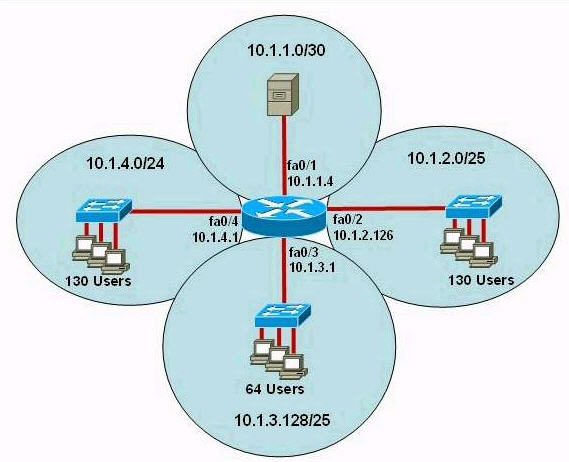
Refer to the exhibit. The goal of this network design is to provide the most efficient use of IP address space in a network expansion. Each circle defines a network segment and the number of users required on that segment. An IP subnetwork number and default gateway address are shown for each segment.
What are three problems with the network design as shown? (Choose three)
A – Interface fa0/3 has an IP address that overlaps with network 10.1.3.0/30.
B – Interface fa0/1 has an invalid IP address for the subnet on which it resides.
C – Interface fa0/2 has an invalid IP address for the subnet on which it resides.
D – Network 10.1.2.0/25 requires more user address space.
E – Network 10.1.3.128/25 requires more user address space.
F – The IP subnet 10.1.1.0/30 is invalid for a segment with a single server.
Answer: A B D
Explanation
Answer A should be “Interface fa0/3 has an invalid IP address for the subnet on which it resides” to be the correct answer. But there is no better solution (answers C E F are obviously incorrect) so we must choose answer A.
Question 2:
If an ethernet port on a router was assigned an IP address of 172.16.112.1/20, what is the maximum number of hosts allowed on this subnet?
A – 1024
B – 2046
C – 4094
D – 4096
E – 8190
Answer: C
Question 3:
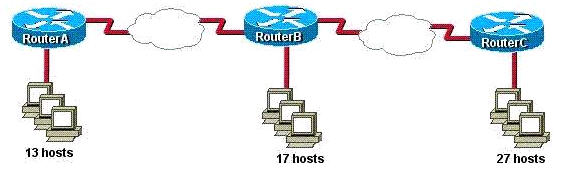
Refer to the exhibit. The internetwork is using subnets of the address 192.168.1.0 with a subnet mask of 255.255.255.224. The routing protocol in use is RIP version 2. Which address could be assigned to the FastEthernet interface on RouterA?
A – 192.168.1.31
B – 192.168.1.64
C – 192.168.1.127
D – 192.168.1.190
E – 192.168.1.192
Answer: D
Question 4:
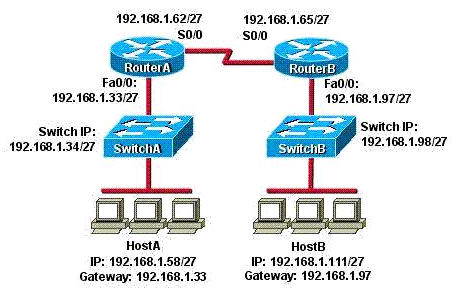
Refer to the exhibit. HostA cannot ping HostB. Assuming routing is properly configured, what could be the cause of this problem?
A – HostA is not on the same subnet as its default gateway.
B – The address of SwitchA is a subnet address.
C – The Fa0/0 interface on RouterA is on a subnet that can’t be used.
D – The serial interfaces of the routers are not on the same subnet.
E – The Fa0/0 interface on RouterB is using a broadcast address.
Answer: D

Sorry meant fa0/3 interface not fa0/1.
i will be taking my Icnd1 in few weeks time, can someone help me with latest dumps materials at noamnotjoking@yahoo.com . thanx in advance
Please Explain
Question1: What is the first valid host on the subnetwork that the node 172.27.1.160 255.255.254.0 belongs to?
Answer: 172.27.0.1
Question2: What valid host range is the IP address 172.24.251.211/21 a part of?
Answer: 172.24.248.1 through to 172.24.255.254
@Andy
Q1 The mask is 255.255.254.0 .. so we need to break Network in the 3rd Octate and the increment is 2.
So first consider the Network 172.27.0.0 which we need to break in 3rd Octate with increment of 2.. so it follows:
172.27.0.0 –
172.27.2.0 –
172.27.4.0 –
.
.
and it goes on..
Now if you complete each address range it comes like this:
172.27.0.0 – 172.27.1.255
add one bit to the last octate of the last address and the next range will be
172.27.2.0 – 172.27.3.255 .. and it goes on.
So the node 172.27.1.16 clearly lies in the range 172.27.0.0 – 172.27.1.255 since we cannot use the first address in the range the first valid IP will be 172.27.0.1.
Q 2. Consider the classfull address 172.24.0.0 with mask /21 or 255.255.248.0
So we break the Network on the 3 octate with increment of 8
The ranges that comes out..
172.24.0.0 –
172.24.16.0 –
172.24.24.0 –
.
.
.
172.24.248.0-
So the range that we are getting here is
172.24.0.0 – 172.24.15.255
172.24.16.0 – 172.24.23.255
.
.
172.24.248.0 – 172.24.255.255
Not considering the fist and the last IPs in the range valid host range will be 172.24.248.1 through to 172.24.255.254.
I hope this helps..
Correction Q 2:
we break the Network on the 3rd octate with increment of 8
So the ranges that comes out..
172.24.0.0 –
172.24.8.0 –
172.24.16.0 –
172.24.24.0 –
.
.
.
172.24.248.0 –
So the range that we are getting here is
172.24.0.0 – 172.24.7.255
172.24.8.0 – 172.24.15.255
172.24.16.0 – 172.24.23.255 .. and so on..
Sorry I missed here and there in hurry.. but the logic is correct 🙂
Actually, I agreed with shariq becuase in the diagram 10.1.3.0/30 network is not being assigned in any of the host interface. No overlapping happened here as 10.1.3.1 IP is not been assign.
How can Q1, A be correct?
The Fa0/3 ip adress 10.1.3.1 is ON the 10.1.3.0 network, thus it doesnt overlap it.
It cant however be the gateway for 10.1.3.128 /25 network as it is a different network..
B & D are correct so could the third answer be F? I mean.. its not invalid per se, still i dont think Cisco approves of that kind of subnetting
Hi guys, im writing my exam on frid da 23rd..so far it has been been me and cbt nuggets training videos, 9tut, examcollections and more subnetting questions
can someboduy help me on this one.
1.How many hosts could you put on each subnet of 1.0.0.0 if you used a mask of 255.25.248.0? How many subnets would you have created?
a) 2048 useable hosts. 8190 subnets
b) 2048 useable hosts. 8192 subnets
c) 2046 useable hosts. 8190 subnets
d) 2048 useable hosts. 8192 subnets
answer: D
I do understand the first portion of useable hosts, but the subnets?? can somebody give clearity on how they got 8192 subnets
@daphly
255.255.248.0 is in CIDR notation /21
255 = 1111 1111 (8 bits)
248 = 1111 1110 (5 bits)
8+8+5 = 21 bits
it is a class A address (1.0.0.0) so the first 8 bits can not be touched.
there are 21-8 = 13 bits for the subnets.
2^13 = 2^10 * 2^3 = 1024 * 8 = 8,192 subnets
how many hosts per subnet?
there are 32-21 = 11 bits for the hosts
2^11 = 2^10 * 2 = 1024 * 2 = 2048
keep in mind that the first and last IPs on any subnet are reserved.
that leaves 2048 – 2 = 2046 hosts per subnet
the correct answer is: 2046 hosts, 8192 subnets (none of the options given by you…)
Thanx xallax, actually I made a typing error its supposed to be 2046 useable hosts
@daphly
you must be able to do subnetting math as seen above in less than a minute (20-30 seconds max).
i’d recommend you start reading 9tut’s subnetting tutorial:
http://www.9tut.com/subnetting-tutorial
cheers
thanx xallax and everybody..passed with 850 now m offf to ICDN2 exam! Wooooop woooop
Max,Thanks for the information. I feel that not all csmotuers deserve a /48. I work for a Co-location facility and we also have several DSL and ATM csmotuers. So I am looking into the implementation for our csmotuers; If we follow the RFCs and guidelines, then I honestly feel that giving a Co-location customer /48 is a waste of address space if the customer only requires a handful of subnets, it would make more sense to give the customer a /56. We also implement HSRP for csmotuers that have IPv4 connectivity, so when the time comes to implement IPv6 and HSRP (There is anycast), but for now, we are looking at all options and the best scalable method; So in the case with HSRP and IPv6, it does not make sense configuring a vlan interface with a /64. I see that maybe configuring the SVI with a /120 and then routing a /56 or a /48 to the csmotuers router from the /120. I have reviewed many RFCs and the discussion for subnets that are longer than a /64 and what is breaks and so fourth, so I am just trying to get an idea what others have implemented.Thanks for your time.Chris
I am totally having some unfortunate luck with all of my Cisco attempts for 640-802 and then stepping down to doing the two part 640-822 and 640-166. On my last two failed attempts with the 802 exam, I failed both exams by 10 points which caused me to go hysterical. When I decided to go for the 640-822 test, I studied hard for another 3 weeks with all sorts of tools provided:
– Leadpass
– CBT Nuggets
– Testout
– Boson 7.0 Netsim
– ITU
– Cisco Press ICND1 book by Wendell Odom
– Cisco Packet Tracer
– 9tut
– ExamCollection
– VCE
– subnettingquestions.org
and I still ended up failing for with a 775/1000. I was for sure that I passed the exam when I was killing all of my practice material. I definitely do not know what is going on and this is extremely disturbing. I keep seeing others with great success stories, and I’m trying to reach that pinnacle also to relay my experiences, but damn, I’m in a hole I can’t get out of. Can anyone out there feed me some of the latest dumps for the ICND1 exam. I would definitely appreciate this as I’m trying to be a family member in the Cisco world.
I can be reached easily at cehiem@yahoo.com…
Roermond, 10 nov. 2010.LS,As a 76-year-old I must teach myself all the neisseacry lessons about the PC. To acquire knowledge for the amateur is difficult. It is there but quite often for a layman very difficult to understand and to put into practize.Your explanation is for me of an enormous value; I am very grateful,as I do understand your directions, AND IT LEADS TO SUCCESS.Thank you very much.D.A. Bokhorst.The Netherlands.VA:F [1.9.13_1145](from 0 votes)
Assuming a subnet mask of 255.255.248.0, three of the following addresses are valid host addresses.
Which are these addresses? (Choose three.)
A. 172.16.9.0
B. 172.16.8.0
C. 172.16.31.0
D. 172.16.20.0
Answer: ACD
but 31 is broadcast address
please anyone can explain me
@rama
given the mask of 255.255.480.0, thus your range is 8 (256-248=8).
the network is 172.16.8.0
range of addresses is 172.16.8.1 thru 172.16.255.254, thus any addresses in between are valid which is ACD.
@Anonymous thanks yes its true..
thnx alot pass my ICND1 wth 912 yesta
thnx alot passd my ICND1 exam yesta wth 912
The question 4 is wrong! You can have 2 questions that are right!
The A and D.
I say this because Host A is not on the same subnet as is default gateway
Proof
(32 Network) 33-46 (47 Broadcast) – This is where Default Gateway Is
(48 Network) 49-62 (63 Broadcast) – This is where host A Is
So that have 2 right answer’s
Anyone want to know the reasoning as to why Q3 is “D”, 192.168.1.190
192.168.1.0/27
255.255.255.224
Increment is 32
192.168.1.0 – 192.168.1.31
192.168.1.32 – 192.168.1.63
192.168.1.64 – 192.168.1.95
192.168.1.96 – 192.168.1.127
192.168.1.128 – 192.168.1.159
192.168.1.160 – 192.168.1.191 – this being the network in question
192.168.1.192 – 192.168.1.223
The question is a mind warp, even mentioning RIP is irrelevant to the situation so ignore that. “Internetwork” being the key term in my mind here. So we should have two (2) networks for RouterA-RouterB, then RouterB-RouterC, certainly I wouldn’t waste a /27 on those but in the framework of this question what is one to do?
After looking closely, 31, 64, 127 and 192 are unusable addresses. This one made me work for the answer.
@anonymous
Question 4 only has 1 answer, D
/27 = 255.255.255.224
Block Size = 32
Subnet= 192.168.1.32
Valid Host Range:
192.168.1.33 – 192.168.1.62
Thus Host A’s IP and Default Gateway are both in the range, as is SwitchA’s IP.
Man, question 1 answer A is tricky. Took me a few to figure it out. It’s overlapping because different subnets but same address. Tricky
Still confused on the first question, Answer A. Answer A states that Fa0/3 has an IP Address that overlaps with 10.1.3.0/30. What it seems like it should say is that Fa 0/3 has IP addresses in different subnets. The wording is incorrect. Not sure how the statement ‘overlaps with 10.1.3.0/30’ makes sense, since there is no /30 and the problem is not overlapping addresses, but instead addresses in different subnets. What am I not understanding here?
Still confused on the first question, Answer A. Answer A states that Fa0/3 has an IP Address that overlaps with 10.1.3.0/30. What it seems like it should say is that Fa 0/3 has IP addresses in different subnets. The wording is/seems to be incorrect. Not sure how the statement ‘overlaps with 10.1.3.0/30′ makes sense, since there is no /30 and the problem is not overlapping addresses, but instead addresses in different subnets. What am I not understanding here?
It seems that for the /25 subnet based on the fa/03 diagram,
the valid subnets are 10.1.3.0-127 and 10.1.3.128-255. Not sure why considering a /30 for this interface would be relevant based on the diagram.
Hi, I will be retaking the ICND1 exam tomorrow and am pretty ready this time. However, I don’t understand why B is one of the correct answers for Q1. Aren’t the valid subnets for the 10.1.1.0/30 network inclusive of 10.1.1.0, 10.1.1.4, 10.1.1.8…. ? Which would make interface fa0/1 a valid IP address for the subnet in which it resides ????
Thanks.
@Retake
B is a right answer because Fa0/3 is on a different network than the one that has been determined. The range of this network is 10.1.3.129-10.1.3.254. Fa0/3 is on the 10.1.3.1-10.1.3.126 network.
I signed up for this web site and paid pay pal, but the login does not recognize my user name and password.
@Frank
Actually B is the right answer because subnet 10.1.1.0/30 has an IP range of 10.1.1.0 – 10.1.1.3, therefore the IP address 10.1.1.4 on fa0/1 would be invalid.
I m kinda new at networking….can someone plz tell me what f/a stands for…
Like fa0/3…..what does that means…
Curious, it stands for “Fast Ethernet”
Guys has anyone see the problem that i am seeing on number 1 ANSWER C IS SAYING: C – Interface fa0/2 has an invalid IP address for the subnet on which it resides. This is true becoz the subnet indicates that it has 130 hosts, of the the topology used /25 meaning to say we’re left with 7 bits that will give us 128 hosts when in actual fact we need 130 hosts. So think C could as well be taken as an answer since the explanation on A is wrong or its a typo error. IP Add 10.1.2.126 being used on fa 0/2 is wrong if we’re to accommodate 130 hosts
To accomodate 130 hosts we need 8 bits that will give us 256-2=254 so i feel C is one of the Answers. I stand to be corrected
i hope to pass the exam! but how its my dream
Although you are correct that /25 cannot accomodate 130 hosts, awser C is still correct since the question states: C – Interface fa0/2 has an invalid IP address for the subnet on which it resides.
The subnet is /25 that means the broadcast address = .127 since the address on fa 0/2 = .126 its still a valid address within that subnet.
any changes on cisco since jan 2013
Any available dumps or guidance please email me at bkboi81@yahoo.com
Hello 9Tut and you all. I am taking my exam next week ICND1 and I would appreciate if you could email me any available dumps.. email: achilleas1979@windowslive.com
Thank you in advance.
can u give me answer the what is the valid last address of this ip 192.168.215.227 / 27
plz help me …i am waiting u.
thanks
can u give me answer the what is the valid last host address of this ip 192.168.215.227 / 27
plz help me …i am waiting u.
thanks
@ asad usmnai The information for the addresses 192.168.215.227/27 is the following:
Network Address: 192.168.215.224/27
Valid Hosts: 192.168.215.225 – 192.168.215.254
Broadcast Address: 192.168.215.255
Q3 was in the exam today
@chas yes !!! i just stick to one method of subnetting!
FIND A METHOD FOR SUBNETTING AND LEARN IT UNTIL YOU CAN ANSWER THE FOLLOWING QUESTIONS:
-How many borrowed bits? from /8, /16, /24
-how many Host bits? 32-x (host bits)= y ^2
-What are my blocks for this CIDR/VLSM- 128 64 32 16 8 4 2 1
-what is my subnet mask?= .0 .128 .192 .224 .240. 248 .252 .254 .255
Can I please get explanation for question 1?
Question 1
Why A? fa0/3 has and ip address of 10.1.3.1 and the network is 10.1.3.0/30 We look at /30 which would give us a subnet of 255.255.255.252 and the magic box number:
128 192 224 240 248 252 254 255
128 64 32 16 8 4 2 1
255 127 63 31 15 7 3 1
Look at the number below the 252. and you have 4, so the ip block range goes from:
0|1-2|3
4|5-6|7
8 and so on. Now 10.1.3.1 is in the same ip range of 10.1.1.0 so therefore 10.1.3.1 thru 10.1.1.2 is a no go for it overlaps the ip range of 10.1.3.0/30
Now why B? look at the magic number above is 10.1.1.4 in the same range as 0|1-2|3? nope so it is wrong.
Why D? This one is easier than you think. Here is how I write it so I am not doing math or counting by 2’s in my head:
2 /31
4 /29
8 /29
16/ 28
32 /27
64 /26
128 /25
256 /24
and so on just do 256*2=X*2 and keep counting down I stop at 8192 /19
Now we look at the /number and match it to the list above. /25 = 128 – 2 (we are dealing with host so -2) = 126 does this = or >130? No you we need to change it to /24 to give us 256-2=254 host that we can use to meet the 130 host needed.
I hope this helps
@Anonymous (or anyone else discussing Q1), where are you getting that fa0/3 is a /30? The only interface that’s on a /30 is fa0/1 (10.1.1.0 /30), right?
The question says fa0/3 is on a /25 (10.1.3.128 /25 to be precise). I completely get that fa0/3’s IP address, 10.1.3.1, IS on a DIFFERENT subnet than it’s hosts are (fa0/3 is on the 10.1.3.0 subnet and the hosts are on the 10.1.3.128 subnet), making it an invalid IP here.
What I still don’t get is the description of the answer, that “fa0/3 has an IP that OVERLAPs with the network 10.1.3.0 /30” Where is that network? Am I missing something here?
The kicker to me in all of this is that B, “Interface fa0/1 has an invalid IP address for the subnet on which it resides.” is one of the correct answers here and IS EXACTLY THE SAME SITUATION we’re discussing with A. Option C is a wrong answer, but its worded the exact same way as B, for the same situation also… Seems to me that Cisco got a little too cute here for no real reason. If option A were “Interface fa0/3 has an invalid IP address for the subnet for which it resides.” then there would be little to no confusion.
Question: Show run>>>>>>
Router(config)#do show ip int br
Interface IP-Address OK? Method Status Protocol
FastEthernet0/0 10.1.3.1 YES manual up up
FastEthernet1/0 10.1.3.1 YES manual administratively down down
Router(config)#interface fastEthernet 1/0
Router(config-if)#no shut
% 10.1.3.0 overlaps with FastEthernet0/0
FastEthernet1/0: incorrect IP address assignment
Router(config-if)#
Is 9tut is under maintenance. ?
because we can’t open many tutorials. ?
including subnetting. ?……
please help me. ?…………
I can’t open 9tut.com. 9tut is under maintenance? please help me?
latest CCNA 640-802 pass4sure dumps in PDF format is available in http://url.mn/h/5a9ca34
Higuys can someone pls explain how come the answer is: 4092 in Question 2
and in Question 3 is D Pls I will glad is someone can explain or kindly send an email to this address: mncedisiwiseman5@yahoo.com
Q3 Explanation….
All ip addresses given in the option are Network and Broadcast ip addresses. The question asked for an ip address (Usable address), therefore we need to assign it the address that is not a Network nor Broadcast Address.. “0.32.64.96.128.160.192. = .63.95.127.191” <<>>> 190 is the only address that can be use cause is falls in the 160 block as a usable ip.
Im taking my ccent today noon..9tut and cbt nuggets. With one on one help from CCNP’s and lots of prayer. Pray i pass!!!
Why is question # answer ‘D’?
Couldn’t ANY of those subnets have 13 hosts?
We have decided to open our POWERFUL and PRIVATE website traffic system to the public for a limited time! You can sign up for our UP SCALE network with a free trial as we get started with the public’s orders. Imagine how your bank account will look when your website gets the traffic it deserves. Visit us today: http://hand9.pw/2310
Lisa http://hand9.pw/2310
We are trying to set up a Class C network with 2 different customers on the same network. I am trying to figure out how to split the 254 hosts between the 2 customers without needing a whole seperate network.
please explain question 3
Question from Anonymous September 23rd, 2016
We are trying to set up a Class C network with 2 different customers on the same network. I am trying to figure out how to split the 254 hosts between the 2 customers without needing a whole seperate network.
Answer
254 is maximum number of ip addresses for a class C address. It cannot be split amongst 2 customers. You can only have one host in this range 1-254