
Wireless Questions
Here you will find answers to Wireless Questions – Part 1
If you are not sure about Wireless, please read my Wireless tutorial and Basic Wireless Terminologies
Question 1
Which wireless LAN design ensures that a mobile wireless user will not lose connectivity when moving from one access point to another on the WLAN?
A. Utilizing MAC address filtering to allow the client MAC address to authenticate with the surrounding APs
B. Using adapters and access points manufactured by the same company
C. Overlapping the wireless cell coverage by at least 10%
D. Configuring all access points to use the same channel
Answer: C
Explanation
By using more than one Access Point (AP) we can create overlapping cells to allow roaming in a larger area. But we have to ensure that two APs must have at least 10% coverage overlap and they use non-overlapping channels.
Question 2
You need to troubleshoot an interference issue with the wireless LAN. Which two devices can interfere with the operation of this network because they operate on similar frequencies? (Choose two)
A. Microwave oven
B. AM radio
C. Toaster
D. Copier
E. Cordless phone
F. IP phone
G. Ipod
Answer: A E
Explanation
Microwave oven and cordless phone radiate energy in the 2.4 GHz unlicensed band so they can interfere with some WLAN standards. As the result of that, you can’t hear clearly on the phone or can’t surf web.
Question 3
Which of the following data network would you implement if you wanted a wireless network that had a relatively high data rate, but was limited to very short distances?
A. Broadband personal comm. Service (PCS)
B. Broadband circuit
C. Infrared
D. Spread spectrum
E. Cable
Answer: C
Explanation
Infrared typically requires a line-of-sight (your TV remote control, for example) which means that it is limited to very short distances. I am not sure if it is considered “relative high data rate” but infrared can transfer up to 4Mpbs.
Question 4
You need to add a wireless access point to a new office. Which additional configuration step is necessary in order to connect to an access point that has SSID broadcasting disabled?
A. Configure open authentication on the AP and the client
B. Set the SSID value in the client software to public
C. Set the SSID value on the client to the SSID configured on the AP
D. Configure MAC address filtering to permit the client to connect to the AP
Answer: C
Explanation
Service Set Identifier (SSID) is the term to identify a WLAN. In most cases SSID is broadcast by the AP, the user only needs to select that SSID and provides a correct password to access it. But in some cases for security reason, the SSID can be disabled. Users can only access to that network if they type both SSID and password correctly.
Question 5
You need to secure a new access point on the a wireless network. Which two practices help secure the configuration utilities on wireless access points from unauthorized access? (Choose two)
A. Changing the default SSID value
B. Configuring traffic filtering
C. Changing the mixed mode setting to single mode
D. Configuring a new administrator password
E. Assigning a private IP address to the AP
Answer: A D
Explanation
To improve security, you should change the default SSID value on your AP. For example, Linksys routers (which are produced by Cisco) typically have an SSID of “linksys” -> A is correct.
In an AP we can configure traffic filtering but it is mainly used for filtering which services clients can use, IP ranges, ports, websites, time access… It has no effect on securing your AP -> B is not correct.
“Mixed mode” here means we can configure AP to allow clients to use different standard like 802.11b, g or n. But setting it to single mode doesn’t have any security protection on it -> C is not correct.
We should also change the administrator password because everyone can access to the admin page of an AP by open a web browser and type the IP address of that AP (for example: http://192.168.1.1). Typically, Linksys Wireless routers have a default username/password of “admin/admin” or “admin/[blank]” which are easily guessed or found out -> D is correct.
We can access the AP by using a private IP address (in the same private network of the AP – 192.168.1.1, for example) -> E is not correct.
Question 6
You need to determine the proper security settings on a new WLAN-capable office. Which encryption type would WPA2 use in this office?
A. PSK
B. AES-CCMP
C. PPK via IV
D. TKIP/MIC
E. None of the other alternatives apply
Answer: B
Explanation
Advanced Encryption Standard (AES) is the cipher system used by RSN. It is the equivalent of the RC4 algorithm used by WPA. However the encryption mechanism is much more complex and does not suffer from the problems associated with WEP. AES is a block cipher, operating on blocks of data 128bits long.
CCMP is the security protocol used by AES. It is the equivalent of TKIP in WPA. CCMP computes a Message Integrity Check (MIC) using the well known, and proven, Cipher Block Chaining Message Authentication Code (CBC-MAC) method. Changing even one bit in a message produces a totally different result.
The AES-CCMP encryption algorithm used in the 802.11i (WPA2) security protocol. It uses the AES block cipher, but restricts the key length to 128 bits. AES-CCMP incorporates two sophisticated cryptographic techniques (counter mode and CBC-MAC) and adapts them to Ethernet frames to provide a robust security protocol between the mobile client and the access point.
Question 7
What is one reason why WPA encryption is preferred over WEP in this network?
A. The WPA key values remain the same until the client configuration is changed.
B. The values of WPA keys can change dynamically while the system is used.
C. The access point and the client are manually configured with different WPA key values.
D. A WPA key is longer and requires more special characters than the WEP key.
E. None of the other alternatives apply
Answer: B
Explanation
Wireless Encryption Protocol (WEP) uses RC4 encryption and a static 64-bit key so it can be easily broken as only 40-bits are encrypted and 24 bits are clear-text IV(Initialization Vector). It was later upgraded to 128-bit, but the IV was still clear text meaning it took slightly longer (minutes) to break-in.
WPA was introduced in 2003 as a replacement for WEP. WPA uses Temporal Key Integrity Protocol (TKIP) to automatically change the keys. TKIP still uses RC4; it just improves how it’s done
Question 8
In an effort to increase security within the wireless network, WPA is being utilized. Which two statements shown below best describe the wireless security standard that is defined by WPA? (Choose two)
A. It requires use of an open authentication method
B. It specifies use of a static encryption key that must be changed frequently to enhance security
C. It includes authentication by PSK
D. It specifies the use of dynamic encryption keys that change each time a client establishes a connection
E. It requires that all access points and wireless devices use the same encryption key
F. WPA works only with Cisc0 access points
Answer: C D
Question 9
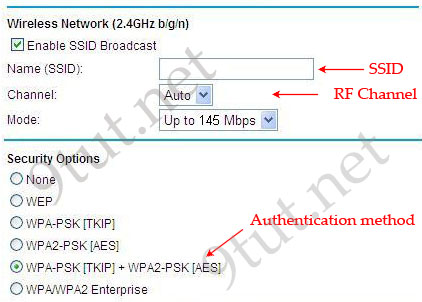
You need to configure a new wireless access point for your network. What are three basic parameters to configure an AP? (Choose three)
A. Authentication method
B. RTS/CTS
C. RF channel
D. SSID
Answer: A C D
Explanation
Below lists basic parameters to configure an AP

Good questions and answers to brush up on. Thanks.
7 out of 9 correct and I didn’t study it in years. I only learned this crap on school 4 years ago. Easy peasy.
Passed ICND1 today with 962…..Question 4 and 7 were on my exam today
Studied with:
Odom ICND1 Book
Todd Lamle CCNA book
Chris Bryant (thebryantadvantage.com)
Andre, if you’re that clever then you would know you should have phrased your comment ‘I haven’t studied it for years’ and ‘I only learned this crap in school…’
Just thought I’d point that out! 🙂
Makes us wonder if Andre is that clever – ah! Most tech guys don’t write good english 🙂
@ CCIE No.1421
Was going to say the same thing haha 🙂
took ICND1 today 803.11g is a must meaning you should be able to distinguish between 802.11g b and a
@shan 803.11g???? i suppose you meant to say 802.11
The differences are quite simple you just need to master them.
the 802.11b and g are almost similar only that 802.11g uses both OFDM and DSSS and can run from 11mbps to 54mbps the 802.11a on the other hand runs strictly OFDM and b/w is limited to 54mbps…hope you passed the exam…..i did and these dumps got me there with a 958/100….probably the best in east africa:) just saying….thanks peeps(and the owner of this site)
@Amos thanks correcting me you are absolutely right I meant to say 802.11 g
And unfortunately I failed it and got 700 and it was my first attempt and now I’m a little nervous though
how merging will happen
Hey Shan, did you get any questions on IPv6 or 802.11n? Sitting the exam in a few weeks.
I think you shouldn’t be really worried much about 802.11n, at least not for icnd1 and to answer your question no i didn’t have any.
Does anyone know the official definition ofWEP? I’ve come across these four definitions so are:
Wired Equivalent Privacy
Wired Equivalency Protocol
Wireless Encryption Protocol
Wireless Equivalency Privacy
@ccna_wannabe
Wired Equivalent Privacy
http://www.9tut.com/wireless-tutorial/2
Thanks xallax!
Hi 9tut,
Cleared ICND1 this morning with an 874/1000 with 20 minutes to spare. Thought I did better but i’m not complaining, chuffed to clear it 1st time. It was easier than I anticipated, put the hours in studying and you will be fine. This was my first question on the exam. You have pretty much nailed it. show running-config on both devices and answer the 4 questions. The questions above are very close to what was asked. look for clear-text passwords, passwords on the console and vty lines, weak username and password command (cisco) , login local, the number of telnet sessions allowed, is a password configured for Telnet, exec-timeout, will it allow telnet and ssh etc.
I would like to thank 9tut / xallax and the everyone else for all the time you have put into this site. This site helped me pass as most of my questions were on the site!!! From what I remember, some of the questions I got were as follows:
-Security Testlet above, all the information is displayed in the running config, just go through the options given in the 4 questions
-Drag and Drop – DHCP (DORA) / Drag and Drop # 2 (file management – copy flash tftp etc) / DNS,ARP,DHCP (know what they do) / WAN technologies (Frame Relay – Packet switched , ATM – cell switched etc)
-Implementation SIM using show cdp neighbors command / show IP interface brief
-Show configuration SIM (show run / startup command disabled)
-Transport Layer fundamentals – 3 way handshake, TCP/UDP, Flow control
-Protocol process through the layers of TCP/IP stack sending an email using HTTP (SMTP at app layer – TCP at Transport layer – IP at Network layer – ARP at Network access layer)
-Encapsulation (HDLC) – default on Cisco devices
-Troubleshooting connectivity issues – when to use a X-over cable and Straight-through, spot incorrect cable in a diagram / duplex mismatch etc.
-Service Password Encryption and what it does
-What switches do when they get a packet with a destination MAC not in CAM table – Flood
-Indicator lights on a switch – Flashing green, Green etc (what each means – Full/Half duplex, network activity etc)
-Port-security, Mac-address sticky command, know what it does
-know the packet delivery process for the sending across the LAN and WAN (what MAC is used where etc) / ARP
-RIP (what happens when you enter router rip command – defaults to version 1)
-implementing a Static Route to default-gateway 0.0.0.0
-Subnetting,Subnetting,Subnetting (I had about 7 or 8 questions relating to Subnetting, valid host ranges, broadcast / network address etc. Practice and you will be fine. subnettingquestions.org I found really helpful. )
Hope this helps. Remember, do not memorize each question on this site, know the concepts and why they happen and you will be fine. I used CBTnuggets, Cisco Press Book, Packet tracer (I didn’t create any funky topologies, I just used it for working on the IOS entering commands) and subnettingquestions.org.
Onto ICND2 in the new year. Good luck!!!
Hi All, The above comment is copied from the Security Testlet tab. 1st paragraph relates to the Security testlet question.
Hi I wrote my exam for ICND1 on Dec21,2011. Got failed 799 the passing score was 804.
I had a question in which I was asked the Bandwidth of the router.
Q.1
The router was showing 100000 Kbits/Sec
and the options were:
a) 128 Kbits
b) 256 kbit
c) 512 kbits
d) 1.544 kbit it was like that, what is the right answer and why, or how we can calculate it
Q2
Then there was a question about Class A subnetting.
What is true about class A subent
a) Its start in 3rd octet with 192
b) Start in 3rd octet with 128
c) Start in 3rd octet with 00
d) Start in 3rd octet with 0
@nocman
Q1
as long as you’re giving us the correct info, then 100000 kbps was the right answer
Q2
Class A subnetting starts in the 2nd octet with 0, 3rd octet with 0, 4th octet with 0.
it starts in the first octet with 1 and ends at 126
Class A assignable IPs are on this range:
1.0.0.0 ~ 126.255.255.255
😀
Failded today ICND1 779 out of 804 🙁 ..I ran out of time and 4 questions i did not even look at
I I got DORA SIMS, CONFIGURATION SIMS(the one u have to use CDP neighbor to find out the platform and interface of the neighboring devices) from 9tut.com. I also got this question: what is the wireless standard that has 14 channels(can not really remember the exact question)
1- 802.11g
2- 802.11a & b
3- 802.11w
————-NIC
when u find the ip address of the machine
—
a network technitian changed the PC NIC card into full duplex LAN into NIC and after that change the PC is unable to ping the host in the other endof the switch. in the question it was provided the output of the command “show running config” which shows that the interface of the switch is operating half duplex. so the question ask what action can fix this issue?
———-
a network tepology is provided:
boxA——1(200m)——–boxB——2(50m)——boxC—–3—-ISPo . so each box is an empty spot and you need to choose what devices and what type of cable /connections can give efficient and cost effective LAN topology?
1- A switch
b Switch
C router
1 fiber
2 UTP
3 UTP
2- A HUB
B SWICH
C ROUTER
1 UTP CABLE
2 CROSS OVER
3 FIBER
3- A SWITCH
B SWICH
C SWITCH
1 FIBER
SORRY GUYS THIS IS ALL WHAT I REMEMBER 🙁 THE EXAM WAS NOT hard but i found the questions are long and I took my time reading the questions
2 pcs can not ping each other why? provided the switch configuration:
PC1——————-F0/0-Router-F0/1———–PC2
config# interface vlan 1
ip address x.x.x.x
no shutdown
what might be the issue:
interface vlan should be interface f0/0?
cabling issue?
Hi Network,
I had the efficient and cost effective question. Dont know if I got it right but I think I went for one with Switch, Router, UTP, X-over cable.
I Disregarded the options containing a HUB and Fiber Optics as the I believe the HUB will not improve efficiency and Fiber is more expensive than UTP. Maybe someone else can confirm?
Duplex mismatch question, I believe the answer would be to change the duplex so it matches.
14 channels, answer is 802.11b standard
I agree with you IrishDave but who really knows what is the CORRECT answer and what exaclty Cisco is looking for…maybe 9tut can confirm if this is the right answer?!!
@irishdave
you picked crossover cable to connect switch to router?
Thanks 9tut for the site
Wrote exam today..got 799.I need to get more into WLAN Qs.scored 0% on that.
Can anyone explain what DORA means,
Thanks in advance
@anonymous
it stands for the 4 steps that take place during the DHCP request.
Discover – broadcast
Offer – unicast
Request – broadcast
Acknowledge – unicast
http://acronyms.thefreedictionary.com/DORA
All praise to God..
Passed ICND1 today with 950..
@xallax,
You are a genius, Im glad that i’ve asked the DORA question, as it was there in my exam today. Many thanks to you and 9tut for excellent work. All simlets and teslets were form this site.
@xallax
no I did not connect a switch to router using X-over cable. In the question network is referring to if I can recall, you are given a partial network diagram which is a fill in the blanks scenario.
Like I said, I was not sure if I got this right. I was trying to weigh up efficiency with cost.
Had some questions very close to these. Study these questions and you will be fine.
Question 3 was included in ICND1 yesterday
how many of these on here will be on the exam? are they hte exact questions
will be writing ICND1 end Feb
I just passed the ICND1 with 925/1000 today 🙂
i did not have any WLAN Questions at all
@xallax
Discover is a broadcast
Offer is a unicast
Request is also a unicast( because he know where 2 send it now)
Acknowledge is a unicast.
@daniel
request can be broadcast and this is correct for the ccent/ccna level
http://en.wikipedia.org/wiki/Dynamic_Host_Configuration_Protocol#DHCP_request
passed today question 2 in exam
I passed my CCENT 1 exam 20 July 2012 with 912 score, my advice to you guys is that read the question carefully and also eliminate wrong question if ur not sure about the answer.
Good Luck!!!!!
Mpho, congratulations on your Certification.
Please share some of the questions you had on your exam.
good morning, svp the friends, quelqu ‘un be able to decrir exam icnd1? questionaires on what modulates? is this qu ‘il ya also ospf, eigrp, and nat? for icnd1? svp j am confused help me, j ‘ai finished the fornation ccna, then j must take my exam in 2 edges icnd1 then 2, guez_carine@yahoo.fr
I thought frame relay is not packet switched and packet = l3?
On the ICND 1 test, does anyone know how much of the wireless specs will be on the exam?
Also, in how much detail does the exam go into 801.x questions?
I have the test scheduled for first thing next week. I “think” I have ot covered but with Cisco, you never know….
Admin – Please consider moving the answer to be “under” the word answer rather than beside it. It makes it hard to scroll down just enough to see all the possible answers without accidentally seeig the actual answer.
had 1,2,5,7,8,9 on the test, passed with 974. Thanks 9tut
im going to take icnd1 in in two weeks.. who can help me with latest dumps.. this is my first visit to this site.. thank u…
I am totally having some unfortunate luck with all of my Cisco attempts for 640-802 and then stepping down to doing the two part 640-822 and 640-166. On my last two failed attempts with the 802 exam, I failed both exams by 10 points which caused me to go hysterical. When I decided to go for the 640-822 test, I studied hard for another 3 weeks with all sorts of tools provided:
– Leadpass
– CBT Nuggets
– Testout
– Boson 7.0 Netsim
– ITU
– Cisco Press ICND1 book by Wendell Odom
– Cisco Packet Tracer
– 9tut
– ExamCollection
– VCE
– subnettingquestions.org
and I still ended up failing for with a 775/1000. I was for sure that I passed the exam when I was killing all of my practice material. I definitely do not know what is going on and this is extremely disturbing. I keep seeing others with great success stories, and I’m trying to reach that pinnacle also to relay my experiences, but damn, I’m in a hole I can’t get out of. Can anyone out there feed me some of the latest dumps for the ICND1 exam. I would definitely appreciate this as I’m trying to be a family member in the Cisco world.
I can be reached easily at cehiem@yahoo.com…
I have my ICND 1 exam tomorrow (20/12/2012) at 4pm. Spent a long time going through resources such as 9 Tut, Exam Collection and Packet Tracer for sim practice. Feel as though I have not just memorised questions and actually do have understanding of why the answers are the answers. Thought my knowledge was pretty solid until I did a mini 30 question practice exam that I set up last night (from Exam Collection) and revealed some holes in my knowledge. I was just like “oh crap!” Mostly rare topics or asking questions based on obscure material that was causing me to fall down. But then I’ll do another one where it asks me a different set of 30 questions and I’ll do amuch better. I don’t know….I guess I just have to hope the exam tomorrow is kind to me. Feels as though no matter how strong you think your knowledge may be, if Cisco want to trip you up then they will….
Wish me luck. Really hope I can come back on here tomorrow evening with some good news for you guys.
Just to add some background info: I am coming from having completed and passed the entire CCNA Cisco Networking Acadamy course from September 2011 through to July 2012 (even qualified for the exam discount voucher in the process which I have used to reduce the cost of the exam fee for tomorrow), and a failed attempt at the full CCNA exam back in August.
Want to write the ICND1 in 3weeks. I already have most of the practical knowledge can I study and pass in 3weeks?
@Jay and others – take it from someone who has taught from the CCNA Curriculum for about 12 years now. I think the curriculum covers the topics well that are on the ICND’s and CCNA. However, important to note that additional on-your-own studying is necessary. I don’t think the curriculum stresses enough using the show commands to troubleshoot and get information. That is left up to the student. Even I have to review that at times.
Also, sites like this are a tremendous resource because it gets you used to the WAY the questions address the topics which can be invaluable. I have taken the tests and believe me, this site is fantastic. Thanks to the people who maintain this site and thanks to all who contribute.
I just took the exam, and passed it. Most of the questions were from this site, but there were a lot of subnetting problems, a lot of wireless and a few WAN questions. The exam had 50 questions all together, and I run out of time for the last 3. Since I was taking this kind of exam for the first time, lost some time in the process of solving the LabSim questions – I could not get in the CLI mode.
Learning from the book was extremely beneficial, but it is important to get VCE and solve at least one exam.
Hey bythelake How did you solved the CLI issue during the exam? I had the same problem the first time I took the CCENT exam I could not access the CLI. If anyone could provide detail description on how to access the CLI it will be greatly appreciate. Thank you in advance.
Hey bythelake How did you solved the CLI issue during the exam? I had the same problem the first time I took the CCENT exam I could not access the CLI. If anyone could provide detail description on how to access the CLI it will be greatly appreciate. Thank you in advance.
@DD
I had this question on the test as well. i chose, A.) and E.), I think… I just research this and according to the Wiki, 802.11 A B and G standards consist of 14 overall channels, where 3 are non-overlapping, 1, 6, and 11. http://en.wikipedia.org/wiki/IEEE_802.11
So we’re down to 2 options and only need 1 answer. The problem is both of the remaining options are terrible answers. I’ve seen both A & D as the “right” answer for this question. I guess I think the 802.11g answer is worse, so I’d probably, reluctantly, go with A like you did… It’s true that wireless communications are half-duplex and 802.11b did increase the speed over the previous standard. As weak as I think the options are, maybe that’s what they mean by “compensate for the half-duplex nature of wireless communications.”
wish me luck!! :)) using this site, Cisco ccent/ccna icnd 1 (with DVD questions) and CCNA by Todd Lammle (DVD questions), plus packet tracer.
for Q.3 this sentence explained why the answer is C.
Data communication speed
Compared with the wireless communication with a maximum speed of about 100 Mbps, the infrared communication has a potential of 1 Gbps. It also has a much shorter wavelength than wireless communication, which is easily enough for broadband communication. It is optimal for when large-volume data such as video must be sent at a high speed.
Took ICND 1 as a bet for co worker. I’ve been a network engineer for over 6 years. Sometimes you have to go back to the basics to see if you still got it lol. Passed my ICND 1. 890/1000. You need a 804 to pass. The security Testlet was on my exam along with the drag and drop items. One drag and drop item that is not on 9tut is ATM-Cell Switched PSTN-Circuit switched Frame-Packet switched Leased Line- Point to Point. Study Materials were Todd Lammle CCNA videos 6th edition and 9tut only. Good Luck.
799….. unreal… Wiresless questions must be known.
802.11w Protected management frames
Team,
would sincerely request to share the pdf do send it please, my email id is shivuch@rediffmail.com.
well thanks in advance dear friends
qxiurvdfiynelvvpkpqqqivimimpv
home https://www.ultrahoverboard.com