
Wireless Questions 2
Here you will find answers to Wireless – Part 2
If you are not sure about Wireless, please read my Wireless tutorial and Basic Wireless Terminologies
Question 1
You have finished physically installing an access point on the ceiling at a newly opened office. At a minimum, which parameter must you configure on the access point in order to allow wireless clients to operate on it?
A. SSID
B. AES
C. TKIP
D. PSK
E. None of the other alternatives apply
Answer: A
Question 2
Part of the wireless LAN is shown below:
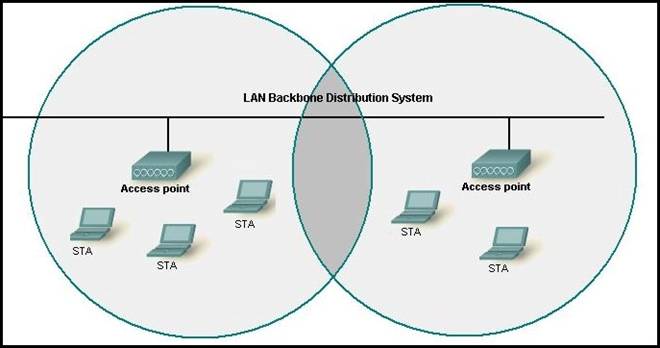
What two facts can be determined from the diagram of the WLAN shown above? (Choose two)
A. Access points in each cell must be configured to use channel 1
B. The network diagram represents an extended service set (ESS)
C. The two APs should be configured to operate on different channels
D. The area of overlap of the two cells represents a basic service set (BSS)
E. The area of overlap must be less than 10% of the area to ensure connectivity
F. There are too many hosts on this WLAN
Answer: B C
Question 3
A single 802.11g access point has been configured and installed in the center of a square shaped office. A few wireless users are experiencing slow performance and drops while most users are operating at peak efficiency. From the list below, what are three likely causes of this problem? (Choose three)
A. Null SSID
B. Mismatched TKIP encryption
C. Cordless phones
D. Antenna type or direction
E. Mismatched SSID
F. Metal file cabinets
Answer: C D F
Explanation
802.11g operates in 2.4 GHz ISM band. Some popular devices and technologies can interfere 802.11g signal:
+ Newer cordless phones
+ Bluetooth
+ Microwaves
+ Metal surface (can cause interference)
+ Antenna (can reduce wireless signal)
Question 4
Three access points have been installed and configured to cover a small remote office. What term defines the wireless topology?
A. SSID
B. BSS
C. ESS
D. IBSS
E. ASS
Answer: C
Question 5
Two workers have established wireless communication directly between their wireless laptops. What type of wireless topology has been created by these employees?
A. ESS
B. IBSS
C. SSID
D. BSS
Answer: B
Explanation
Independent Basic Service Set – IBSS (ad hoc mode) does not use an AP. It allows two devices to communicate directly.
Basic Service Set (BSS) is a single wireless LAN created with an AP and all devices that associate with that AP.
Extended Service Set (ESS) consists of multiple APs, allowing roaming in a larger coverage area.
Question 6
802.1b is being utilized in the wireless network. Which spread spectrum technology does the 802.1b standard define for operation in this network?
A. FHSS
B. IR
C. DSSS and FHSS
D. DSSS
E. IR, FHSS and DSSS
Answer: D
Explanation
Frequency Hopping Spread Spectrum (FHSS) uses all frequencies in the band, hopping to different ones. By using slightly different frequencies for consecutive transmissions, a device can hopefully avoid interference from other devices that use the same unlicensed band, succeeding at sending data at some frequencies.
Direct Sequence Spread Spectrum (DSSS) followed as the next general class of encoding type for WLANs. Designed for use in the 2.4 GHz unlicensed band, DSSS uses one of several separate channels or frequencies.
The original 802.11 WLAN standards used FHSS, but the current standards (802.11a, 802.11b, and 802.11g) do not. 802.1b uses DSSS while 802.1a & 802.1g use Orthogonal Frequency Division Multiplexing (OFDM).
(Reference: ICND1 Official Exam Certification Guide)
Question 7
Which IEEE standard is used to define Wi-Fi?
A. IEEE 802.3
B. IEEE 802.5
C. IEEE 802.11h
D. IEEE 802.11c
E. IEEE 802.11
Answer: E
Question 8
An office is using an IEEE 802.11b wireless LAN. What is the maximum data rate specified for this WLAN?
A. 11 mbps
B. 100 mbps
C. 54 mbps
D. 10 mbps
E. 1000 mbps
F. 16 mbps
Answer: A
Explanation
The maximum data rate for popular WLAN standards are listed below:
* IEEE 802.11a: 54 Mbps in the 5.7 GHz ISM band
* IEEE 802.11b: 11 Mbps in the 2.4 GHz ISM band
* IEEE 802.11g: 54 Mbps in the 2.4 GHz ISM band

Passed ICND1 today. I had about 2 of these questions on it. Thanks 9tut. I will donate in a few minutes. I appreciate the site.
Passed ICND1 today with 962…..I had question 1 on my exam today.
Studied with:
Odom ICND1 Book
Todd Lamle CCNA book
Chris Bryant (thebryantadvantage.com)
jay1 u forgot to donate ur 2 questions
Taking my ICND1 exam tomorrow…..and i am confident i will pass.
@ MAC, how did the exam go ? im writing the exam on 20th. can i g3t some useful info from U regarding latest dumps or which resource was the best for prep.
mohsin_saleem@live.com
thanks
Mac – did you fail? Is that why you haven’t provided an update?
on Q5: I have doubts on the answer, since the IBSS I’ve knowned is (Infrastructure Basic Server Set) IBSS involves 1 AP connected to the wired network. My answer for this question is Ad hoc..
What can you say about this? Any comments are higly appreciated.
Thanks!
@Neo: There are two types of BSS namely IBSS (Independent Basic Service Set) and Infrastructure Network. The IBSS are the ad-hoc wireless networks that generally consist of client machines without an access point whereas the Infrastructure Network Service set comprises of both the networking stations and the AP(Access Point).
In short, Independent Basic Service Set is abbreviated as IBSS while Infrastructure Basic Server Set is abbreviated as BSS only.
I did my ccna 640-802 exam and what i can say is that you really got to know your stuff well when you go do this exams because time is not going to be on your side.Ooh!!! by the way i failed the exam by 142 points.I want to go do the ICND 1 on the second week of December.Whichever the exam goes i will donate questions.
i’ll take ICND1 tommorow … wish me luck guys .. thanks 9tut give me more exercise ..
Hi laila, how was your exam , what kind of qn’s were there?
Please help as I am about to give my exam within next 2 days….
Thanks all 🙂
Hey Laila and Luvj, how was exam went?
Came across a question relating to wireless 802.11a/b/g and 802.11w. Although the answer appears to be the only correct one, I was not too sure about the 802.11w. Any thought on this?
@chas, I came across the question too…Can anyone rephrase that question and give tell as to what was the right answer ?
@chas @glas
from wiki:
“Current 802.11 standard defines “frame” types for use in management and control of wireless links. IEEE 802.11w is the Protected Management Frames standard for the IEEE 802.11 family of standards.”
802.11w is a security protocol that applies to .11a, .11b, .11g, .11n 🙂
@Xallax,
I’ve answered that question correctly then. Passed the exam but still like to know the correct answer.
Thanks Xallax and Glam
In the diagram Q2, could someone confirm what the “overlapping” area is called? And does the backbone have an acronym when used in this context? Thanks all.
2, 3 included in ICND1 yesterday with additional question about choosing the Wireless standar and the choices more or less are a. 802.11 b. 802.11a c. 802.11g d. 802.11a/b, 802.11g,802.11w
Also got the one Lanz posted, however as memory serves me 802.11w was in more than one option, wich as far as i know is not a standard. I still got it wrong though 🙁
I came across this site, and put some time to view the content. 9tut has done an awesome job, the best i liked was the explanation to the answers provided. hats off 9tut. BTW i am giving my ICND1 and ICND2 in early march.
Q1… all access points come with a pre-configured SSID, or at lease none I have ever dealt will in the last 15 years or so. Yes, the SSID should be changed for security and information purposes. The SSID does not need to be configured to a new name to access the access point. OBTW how do you change the SSID? By accessing the access point.
I’M TAKING MY ICDN1 TUESDAY WISH ME LUCK
I KNOW I WILL PASS
THANKS
I PASS ICND1 TODAY I GOT 899 AFTER TWO TRY KNOW YOUR STUFF
Studied with:
Odom ICND1 Book
Todd Lamle CCNA book
CBT NUGGET
i passed with 925 in 31 of march, no questions were in exam related to WLans
Hi all.
Where can I find “atm frame relay cell” for ICND1?
I am taking test this week.
Can somebody help me with this because I was thinking that frame relay for eg. will be covered in ICND2… 🙁
@ NRK — “Q1… all access points come with a pre-configured SSID,…”
You are right. I was also going to ask the same question.
@ 9tut —- When a default SSID is already present on any AP, then no minimum changes are required to make the AP working. Or if it is so that with default SSID APs do not allow communication. I think it is not so.
====================================
For bank PO exam preparations visit : http://www.bankingexams.com/
Oh! this site is cool. About to resit my Icnd1 nxt wk. Thanks alot & hope I w’l make it.
Had questions 2, 4, and 8. Passed 9/23/12 with a 974. This website is awesome and is a great representation of whats on the test. I had the DORA drag and drop, and also the WAN protocol DAD. The security testlet was on there. Chose banner as part of my answers and got 100% in that area. I had lots of subnetting questions, so if you are not comfortable with subnetting, practice. For studying I used this site, cisco (for the subnetting game, and also went through their review questions), and attended a CCNA course at a certified cisco learning partner. Also had the implementation drag and drop. thanks 9tut, on to ICND2. Good luck everyone.
I’m sorry,but what is WAN protocol DAD?
Raha DAD= drag and drop. question type on exam
What is the Wan Dad?? Can some one type the qn here pls
i’ll have icnd1 exam tommorw and i have a baby preventing me from studying but i am doning my best plaese wish me a good luck
thanx 9tut
thanx 9tut
I WILL TAKE icnd1 this december… wish me luck ;))
I’m going to take mine in December also. A friend of mine is taking her’s this coming Friday morning
I am totally having some unfortunate luck with all of my Cisco attempts for 640-802 and then stepping down to doing the two part 640-822 and 640-166. On my last two failed attempts with the 802 exam, I failed both exams by 10 points which caused me to go hysterical. When I decided to go for the 640-822 test, I studied hard for another 3 weeks with all sorts of tools provided:
– Leadpass
– CBT Nuggets
– Testout
– Boson 7.0 Netsim
– ITU
– Cisco Press ICND1 book by Wendell Odom
– Cisco Packet Tracer
– 9tut
– ExamCollection
– VCE
– subnettingquestions.org
and I still ended up failing for with a 775/1000. I was for sure that I passed the exam when I was killing all of my practice material. I definitely do not know what is going on and this is extremely disturbing. I keep seeing others with great success stories, and I’m trying to reach that pinnacle also to relay my experiences, but damn, I’m in a hole I can’t get out of. Can anyone out there feed me some of the latest dumps for the ICND1 exam. I would definitely appreciate this as I’m trying to be a family member in the Cisco world.
I can be reached easily at cehiem@yahoo.com…
Getting ready to renew my CCNA. This time I am taking each of the individual tests vs. the single CCNA test. In my opinion, the compreshenvies test would be much easier because its the same number of questions. But since I let it lapse, I’ll just bite the bullet and do each one…and I’ll post my results when I am finished.
How to pass the exam?
Q:How to pass the exam?
A:STUDY!!!
Failed today, but had quite a few questions that I recognized from this site, including Q4 on this page. Guess I’ll have to try again! 🙂
I think Brian is onto something there, good God why didn’t we think of that. Tell us Brian how do you do it and make a profit??
Got Q 4 on my ICND1 today
Question 4 was on my ICND1 today
got 1000. got the security testlet, lab sim about the show cdp neighbors details and several drag and drop. thanks all!
yeah i would go for Database as far as the Common resource question goes for multiple users.
Rest seem correct though
Hopefully taking my exam today…i hope it will be a success cos i am taking the exam in the two-part-way(ICND1 and ICND2)…see u guys when am done…
I JUST FINISHED WRITING ICND1 AND IT WAS A SUCCESS….912/1000 IS THE SCORE…THANKS TO U ALL..MOST OF THE LABS HERE CAME. Q4 WAS IN MINE TOO…ALL THE BEST….
Passed ICND1 yesterday – 937 / 1000. Question 4 was there. This site was a huge help so thanks to all who built it. i also used the Wendell Odom CCENT/ICND1 (3rd edition) book, plus examcollection.com and paid £20 for the VCE software. All highly recommended. Finally, as mentioned many times on this site, know your subnetting!!
Failed ICND1 today.
Question on 2 WAPs with options for A. ESS, B. IBSS , C. SSID , D. BSS. Answered is ESS.
Q:How to pass the exam?
A:(Serious Answer) Read books, 9tut, Bryant, CBT, Todd, Odom.
B:(ANSWER YOU DESERVE) Just book the exam and hope dude, hope.
None of these questions were on my exam but there was one dealing with ESS. just know the basics of all 3. Took ICND 1 as a bet for co worker. I’ve been a network engineer for over 6 years. Sometimes you have to go back to the basics to see if you still got it lol. Passed my ICND 1. 890/1000. You need a 804 to pass. The security Testlet was on my exam along with the drag and drop items. One drag and drop item that is not on 9tut is ATM-Cell Switched PSTN-Circuit switched Frame-Packet switched Leased Line- Point to Point. Study Materials were Todd Lammle CCNA videos 6th edition and 9tut only. Good Luck.
Hello guys..am writing my Exam next, and am feeling pretty confident, wish me luck!
I wrote my ICND1 on the 6th of September, got 787 when passing mark was 804. I’m doing it again on the 28th. I am working on covering more ground and revising questions.
tnx 9tut i made may to ICDN2 i appreciate ur huge assistance to all exam takers