
OSPF Questions
Here you will find answers to OSPF Questions
Note: If you are not sure about OSPF, please read my OSPF tutorial
Question 1
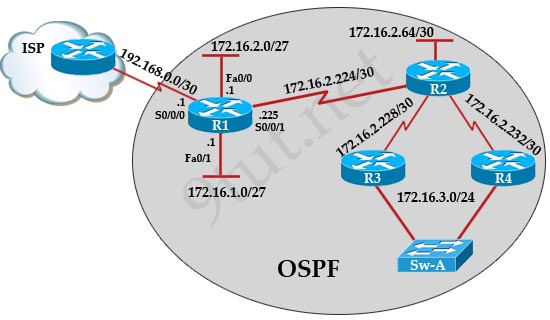
After the network has converged, what type of messaging, if any, occurs between R3 and R4?
A. No messages are exchanged.
B. Hellos are sent every 10 seconds.
C. The full database from each router is sent every 30 seconds.
D. The routing table from each router is sent every 60 seconds.
Answer: B
Explanation
HELLO messages are used to maintain adjacent neighbors so even when the network is converged, hellos are still exchanged. On broadcast and point-to-point links, the default is 10 seconds, on NBMA the default is 30 seconds.
Although OSPF is a link-state protocol but the full database from each router is sent every 30 minutes (not seconds) -> C and D are not correct.
Question 2
R1 is configured with the default configuration of OSPF.
From the following list of IP addresses configured on R1, which address will the OSPF process select as the router ID?
A. 192.168.0.1
B. 172.16.1.1
C. 172.16.2.1
D. 172.16.2.225
Answer: A
Explanation
The Router ID (RID) is an IP address used to identify the router and is chosen using the following sequence:
+ The highest IP address assigned to a loopback (logical) interface.
+ If a loopback interface is not defined, the highest IP address of all active router’s physical interfaces will be chosen.
+ The router ID can be manually assigned
In this case, because a loopback interface is not configured so the highest active IP address 192.168.0.1 is chosen as the router ID.
Question 3
What information does a router running a link-state protocol use to build and maintain its topological database? (Choose two)
A. hello packets
B. SAP messages sent by other routers
C. LSAs from other routers
D. beacons received on point-to-point links
E. routing tables received from other link-state routers
F. TTL packets from designated routers
Answer: A C
Question 4
R1 is unable to establish an OSPF neighbor relationship with R3. What are possible reasons for this problem? (Choose two)
A. All of the routers need to be configured for backbone Area 1.
B. R1 and R2 are the DR and BDR, so OSPF will not establish neighbor adjacency with R3.
C. A static route has been configured from R1 to R3 and prevents the neighbor adjacency from being established.
D. The hello and dead interval timers are not set to the same values on R1 and R3.
E. EIGRP is also configured on these routers with a lower administrative distance.
F. R1 and R3 are configured in different areas.
Answer: D F
Explanation
To become OSPF neighbors, routers must meet these requirements: Hello interval, Dead interval and AREA number -> D and F are correct.
Question 5
ROUTER# show ip route
192.168.12.0/24 is variably subnetted, 9 subnets, 3 masks
C 192.168.12.64 /28 is directly connected, Loopback1
C 192.168.12.32 /28 is directly connected, Ethernet0
C 192.168.12.48 /28 is directly connected, Loopback0
O 192.168.12.236 /30 [110/128] via 192.168.12.233, 00:35:36, Serial0
C 192.168.12.232 /30 is directly connected, Serial0
O 192.168.12.245 /30 [110/782] via 192.168.12.233, 00:35:36, Serial0
O 192.168.12.240 /30 [110/128] via 192.168.12.233, 00:35:36, Serial0
O 192.168.12.253 /30 [110/782] via 192.168.12.233, 00:35:37, Serial0
O 192.168.12.249 /30 [110/782] via 192.168.12.233, 00:35:37, Serial0
O 192.168.12.240/30 [110/128] via 192.168.12.233, 00:35:36, Serial 0
To what does the 128 refer to in the router output above?
A. OSPF cost
B. OSPF priority
C. OSPF hop count
D. OSPF ID number
E. OSPF administrative distance
Answer: A
Explanation
The first parameter is the Administrative Distance of OSPF (110) while the second parameter is the cost of OSPF.
Question 6
Which of the following describe the process identifier that is used to run OSPF on a router? (Choose two)
A. It is locally significant.
B. It is globally significant.
C. It is needed to identify a unique instance of an OSPF database.
D. It is an optional parameter required only if multiple OSPF processes are running on the router.
E. All routers in the same OSPF area must have the same process ID if they are to exchange routing information.
Answer: A C
Question 7
Open Shortest Path First (OSPF) is a routing protocol developed for Internet Protocol (IP) networks by the Interior Gateway Protocol (IGP) working group of the Internet Engineering Task Force (IETF). What is the default administrative distance of the OSPF routing protocol?
A. 90
B. 100
C. 110
D. 20
E. 130
F. 170
Answer: C
Question 8
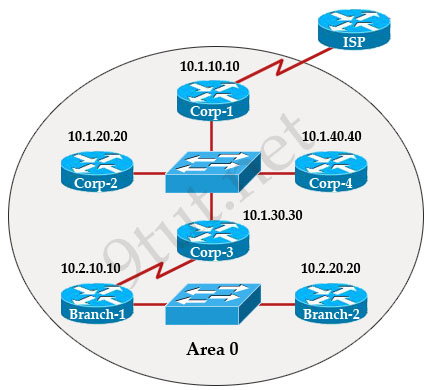
The internetwork infrastructure of company XYZ consists of a single OSPF area as shown in the graphic.
There is concern that a lack of router resources is impeding internetwork performance.
As part of examining the router resources the OSPF DRs need to be known.
All the router OSPF priorities are at the default and the router IDs are shown with each router.
Which routers are likely to have been elected as DR? (Choose two)
A. Corp-1
B. Corp-2
C. Corp-3
D. Corp4
E. Branch-1
F. Branch-2
Answer: D F
Explanation
There are 2 segments on the topology above which are separated by Corp-3 router. Each segment will have a DR so we have 2 DRs.
To select which router will become DR they will compare their router-IDs. The router with highest (best) router-ID will become DR. The router-ID is chosen in the order below:
+ The highest IP address assigned to a loopback (logical) interface.
+ If a loopback interface is not defined, the highest IP address of all active router’s physical interfaces will be chosen.
In this question, the IP addresses of loopback interfaces are not mentioned so we will consider IP addresses of all active router’s physical interfaces. Router Corp-4 (10.1.40.40) & Branch-2 (10.2.20.20) have highest “active” IP addresses so they will become DRs.
Question 9
Which address are OSPF hello packets addressed to on point-to-point networks?
A. 224.0.0.5
B. 172.16.0.1
C. 192.168.0.5
D. 223.0.0.1
E. 254.255.255.255
Answer: A
Question 10
Which statements describe the routing protocol OSPF? (Choose three)
A. It supports VLSM.
B. It is used to route between autonomous systems.
C. It confines network instability to one area of the network.
D. It increases routing overhead on the network.
E. It allows extensive control of routing updates.
F. It is simpler to configure than RIP v2.
Answer: A C E
Question 11
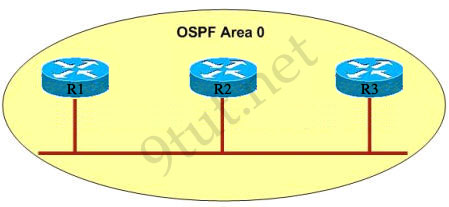
R1 is unable to establish an OSPF neighbor relationship with R3
What are possible reasons for this problem? (Choose two)
A. All of the routers need to be configured for backbone Area 1
B. R1 and R2 are the DR and BDR, so OSPF will not establish neighbor adjacency with R3
C. A static route has been configured from R1 to R3 and prevents the neighbor adjacency from being established.
D. The hello and dead interval timers are not set to the same values on R1 and R3
E. EIGRP is also configured on these routers with a lower administrative distance
F. R1 and R3 are configured in different areas
Answer: D F
Question 12
RouterD# show ip interface brief

Given the output for this command, if the router ID has not been manually set, what router ID will OSPF use for this router?
A. 10.1.1.2
B. 10.154.154.1
C. 172.16.5.1
D. 192.168.5.3
Answer: C

Q still valid Thanks 9tut passed today with 944. i had question 1,2,5,6,8 in the exam
good luck
Q1, Q2, and Q3 in ICND2 today
For question 8, I had to do a little research:
“A designated router (DR) is the router interface elected among all routers on a particular multiaccess network segment”
http://en.wikipedia.org/wiki/Open_Shortest_Path_First#Designated_router
In other words, a group of routers connected to a switch all form part of the same segment, and are used to elect the DR for that single multiaccess interface (switch-adjacent routers). Once that interface is addressed, the next highest address is chosen.
That’s how I understand it, anyway.
Questions 1 & 2 today
I had questions 1 & 2. However, it was one of those that displayed the topology and 5 questions attached to it. One of them asked how many routes would be shown in the routing table of router 1. Choices were 2,4,5,6,7. I had no idea. All in all it is a good idea to analyze the #sho ip route command for your own knowledge. Despite this question I managed to pass.
just passed icnd2 with 972. ospf loading balancing was on the exam. bandwidth and cost were the correct answers. i picked priority which was wrong. i missed this one because it wasn’t on this site. it was the only question i missed. good luck on the current version of icnd2.
Just wrote my ICND2 today, and i got 902/1000.. Question 1, 2, 3, 8, and 11 was in the exam.. Thanks to the 9tut team..
It was nice but i think if question is little bit difficult or add more question for that section then it will be interesting. Overall i enjoyed to solve this section .
I have a doubt in question no. 6 so plz give me explanation of this because i did not understand this answer which u gave.
Explanation for Question 6:
Which of the following describe the process identifier that is used to run OSPF on a router? (Choose two)
It is important to remember that the “process identifier” is not the same as the “area”. You can run multiple instances of OSPF on a single router. The purpose of the Process Identifier is to distinguish between these multiple instances as they will all create separate databases.
A. It is locally significant. ** This number on matters on this router. Other routers cannot even see it **
B. It is globally significant. ** It is not globally significant because it does not have to match any other routers **
C. It is needed to identify a unique instance of an OSPF database. ** It will identify an instance on the local router **
D. It is an optional parameter required only if multiple OSPF processes are running on the router. ** It is still required be entered regardless of multiple instances or not **
E. All routers in the same OSPF area must have the same process ID if they are to exchange routing information. ** Since it is only locally significant, it does not need to match other routers. Only the Area number (which is set on the interface) needs to match other routers **
On Question 2 above, the sequence used by OSPF to select the router ID is wrong. According to Wendell Odom’s Official Cert Guide, the manually set router ID overrides all. Ofcourse you can test this with equipment or packet tracer and see for yourself as well.
So the order will be:
1. The manually set router ID with the “router id ..” OSPF sub-command.
2. If the router ID is not manually set then the highest IP address assigned to a loopback (logical) interface.
3. If a loopback interface is not defined, the highest IP address of all active router’s physical interfaces will be chosen.
So what is the ‘manually set router ID’ in this particular scenario??
Hi guys,
Referring to the Question 2, can somebody please explain to me why 192.168.0.1/30 is the highest IP address , and not 192.16.2.225 ?
Thanks
Ohh. Now I see…. it is 172.x.x.x and the highest is 192.x.x.x.. sorry for the silly question
Took the exam yesterday (got 930 pts)
According the OSPF
one of the new question is:- how many networks learnded R1 from OSPF (i took 2 but this answer is not correct) but there are 6 possibilities (i took the wrong one)
the 2nd new one – i can not remember (sorry)
VTP: something should be changed on the correct (old) router but as i want to check the config – the sim crashes down (every command was not accepted) and so i took only 93% for this sim
FR – sim: same as here but with the misspelled IP.
2-3 new questions but with no big weight for the test result
The level for passing this exam was 825 pts.
Good luck
Nimal is correct on question 2, I read the same thing…
Hey guys i passed my CCND2 and completed my CCNA. i got 972/1000. Question 1 had a new question on it. How many routes would need to be added to R1 in the OSPF table answers was like 1 2 3 or 4. know your OSPF and other routing protocols really well and your IPv6. with the new exam coming in they want you to know your ipv6 routing and wan technologies to the T. I really didn’t get very many questions from 9tut or dumps considering new material is being added so luckily i knew my work really well 🙂 Good luck guys Greetings from south africa 😀 onto the CCNP!!
Can someone please post link to FR – sim?
Thank you
I put the configuration in Q2 into real iron and came up with interesting results. If you start OSPF from R4 and work backward to R1, R4-172.16.3.2 becomes DR and R3-172.168.3.1 becomes BDR. There are no DROTHERS! I tried doing CLEAR IP OSPF PROC on all routers and shutdown interfaces but couldn’t move DR/BDR. I then removed OSPF from all routers and started from R1. in SHOW IP OSPF NEIGH, R2-172.16.2.233 became BDR as seen from R1 and R1-192.168.0.1 became DR as seen from R2. R3 and R4 showed FULL/- from R2. From R3-172.16.3.1 R2 shows FULL/- and R4-172.16.3.2 is DR and from R4, R3 is BDR and R2 shows FULL/-. This makes sense that different segments can have their own DR/BDR.
I didn’t want to confuse the issue but when I loaded OSPF into R3 first it became DR and R4 BDR. Running CLEAR IP OSPF PROC switched them to the highest IP in the segment.
Also in case no one noticed R1 S0/0/1 is .225 not .255
How many OSPF routes will R1 see in SHOW IP ROUTE? 4 the rest are connected
in the above I have a typo R3-172.168.3.1 should be R3-172.16.3.1. You type 192.168 so often the your fingers put in the 8 automatically.
I’ve just created the OSPF sim in PT to test. Feel free to giv it a try:
http://www.sendspace.com/file/i2nbyy
Yes it’s working fine and Oxymorons answer above is correct. There will be 4 OSPF routers in R1’s table 🙂
any comments about the PT file please feel free to send to markel2007-serene at yahoo dot com dot au
Sorry, the above one has R4 routers password mitype. Try this one instead:
http://www.sendspace.com/file/xr8nr2
I was going to say “There will be 4 OSPF routes in the R1’s routing table”..
blehh.. sleepy typos. Give the PT file a try guys and try to create your own so you can understand.
Cheers
@Oxymoron
Designated Router is only needed in a broadcast segment right? Point-to-point segments do not need DRs or BDRs and they are just point to point.
If I’m not mistaken(and I just checked the book quickly as well) The purpose of DR is to act as a central hub in the broadcast segment so all attached routers can you the hub & spoke type of communication to exchange LSAs and Hellos
the reason why you saw the odd selection of BDR is well explained in the Wendell Odom book
“If a new, better candidate comes along after the DR and BDR have been elected, the new candidate does not preempt the existing DR and BDR” (Wendell Odom, CCNA ICND2, 3rd edition, pg 390)
hth someone. Please correct me if I’m wrong. Cheers
failed today with 818 – so..I was 1-1.5 questions off. had an unexpected OSPF hotspot question just like the frame-relay one (which i also got) the OSPF example, i can’t find anywhere on this site..probably got 3/4 on the OSPF. results came back 80%+ in all areas except ACL. which I am ok with doing on the labs etc..know the syntax..but having a hard-time with those..”limit subnet .1 .2 .3 .4 with 2 statements” and that’s what killed it. did not had any eigrp questions. got a total of 4 labs and 3 drag n drops. 3 new questions. going right back next monday.
Q1, Q2, Q6 and Q12 in ICND2 today
Fail. Took the supposed ICND2 640-816 today and there was nothing like the material contained on this site. No VTP, No Drags and Drop (except 1, had Split Horizon), no ACL or NAT. It was all about SNMP and Netflow. 2 Different SIMS OSPF and EIGRP (not on this site or dump) A lot IPV6. I nailed ICND1 exam but this wasnt the test I prepared for. Please reply.
For some reason my exam overlapped and I got 200-100. Didnt know was there already and Fail. 640-816 next Monday.
Hi,
can someone send latest dumps to abc@gump.me.uk
Thanks
Q 1,2 & 7 on today’s exam. Nailed it with 888/1000. Thanks to 9tut, CBT Nuggets, CiscoPress, HeavyMod.
Q 8 was on today’s exam – passed with 944/1000.
Using the same diagram as Q 1, I saw the following question on the 640-816 ICND2 exam today, not word for word but here goes: OSPF is using classful addressing/routing, how many routes will show on R1 router, within the OSPF participating routers/networks? a. 2, b. 3, c. 4, d. 5
I choose b (3).
My question is this: Should I have chosen c (4) to include the default route to the internet.
Thanks, 9tut and exam dumps from Lead2pass!
@Kam702 remember that the RIDs are the highest IP address on the loopback interface or if no interface configured it’s the active interface IP address and there three different networks in this topology so the answer is D and F.
DVD of CBT Nuggets Lectures CCNA , CCNP Routing and Switching is Available price 2000/-pkr
This is really a great articles on how to implement OSPF http://www.certificationkits.com/cisco-certification/Cisco-CCNP-ROUTE-Implementing-OSPF.html and once you understand that, it makes this type of question so much easier to answer on the CCNA exam.
The laptop keyboard is even ergonomically designed in a
five-degree slant, tapered particularly for comfortable use.
“We play the role of more engaging with all the gaming community. I enjoy the more expensive screens 17” or better.
https://www.zotero.org/cheaplaptops